



 +603 9021 3601
 +6019 3163 600
 enquiry_ch@real.edu.my

For many parents, stem education is often associated with science and mathematics results. In reality, strong STEM learning goes far beyond subject content. It develops how students think, question, create, and apply knowledge to the world around them. UNESCO describes STEM as an approach that uses science, mathematics, technical, and engineering knowledge to solve daily and societal problems, which is why it is closely linked to deeper thinking and real world relevance.
In the Malaysian context, this matters more than ever. As education and work continue to evolve, students need more than textbook knowledge. They need creativity, adaptability, and problem solving. OECD’s work on future education highlights that students need knowledge, skills, attitudes, and values that help them thrive in a changing world, while its skills framework notes that creativity and critical thinking are increasingly important for solving complex problems.
STEM Education Is More Than a Group of Subjects
The real value of stem education lies in how it trains the mind. Students learn to observe carefully, test ideas, interpret evidence, and make thoughtful decisions. They begin to see that learning is not about memorising facts for an examination, but about understanding how ideas connect and how knowledge can be used in practical situations. OECD’s work on teaching and assessing creative and critical thinking also supports the idea that schools should build learning environments where these skills are actively developed, not left to chance.
This is also where future skills become important. A student who can analyse information, communicate clearly, and solve unfamiliar problems is better prepared for higher education and modern careers. STEM learning, when taught well, strengthens these habits by encouraging curiosity, experimentation, and confident decision making. UNESCO’s curriculum guidance for STEM education emphasises real life problem solving and authentic learning experiences as central to contemporary STEM practice.
How REAL Schools Brings STEM Thinking into Learning
At REAL Schools, STEM education is positioned as part of a broader future ready learning experience. REAL Schools has publicly described its Future Ready Curriculum as one that integrates STEAM, entrepreneurship, and digital literacy to prepare students for a rapidly changing world. The school also highlights future proof preparation through continuous innovation in teaching methods and technology.
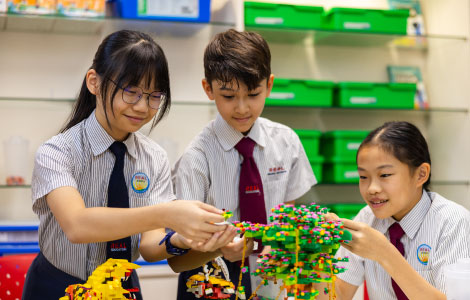
This approach is reinforced by the learning spaces and experiences available on campus. REAL Schools Shah Alam, for example, highlights facilities such as science labs and a makerspace, both of which support practical investigation, experimentation, and applied thinking. The school also describes its Learning for Life approach as one that focuses on the whole student, integrating knowledge, human values, social emotional development, and communication skills.
The Role of Technology for STEM Education
Good STEM education learning also depends on thoughtful use of technology for education. Technology should not be treated as an extra. It should help students visualise concepts, test ideas, gather information, and collaborate more effectively. REAL Schools has publicly shared that its technology integration includes a 1 to 1 iPad programme supported by teacher training and curriculum planning, reflecting a structured approach to digital learning rather than technology for its own sake.
When used with purpose, technology can make abstract concepts clearer and classroom learning more interactive. More importantly, it helps students build the confidence to use modern tools responsibly and intelligently, which is a necessary part of future skills development. OECD has noted that digital technologies can transform teaching and learning practices when used effectively, especially when guided by capable teachers.
From Classroom Strength to Future Direction
At REAL Schools, STEM education is ultimately about helping students turn ability into direction. One example is Lim Zhang Xian, an SPM top scorer from REAL Schools Johor Bahru, who stood out for his strength in Chemistry and Additional Mathematics. He credited his school experience not only for academic growth, but also for the guidance he received from teachers who helped him think clearly, ask questions, and approach learning with purpose. He later continued to Universiti Teknologi Malaysia in the Foundation in Physical Science programme and intends to pursue electrical engineering. For parents, this is a meaningful example of how a strong STEM foundation can support both academic achievement and long term aspiration.
Why This Matters Beyond the Classroom
Parents are right to look beyond exam performance when choosing a school. The long term value of stem education is that it helps students become thoughtful learners who can apply knowledge with confidence. Whether a child goes on to study engineering, medicine, business, design, or law, the ability to reason clearly, think creatively, and solve problems remains essential. UNESCO and OECD both underline that education systems must equip students with these broader competencies if they are to succeed in contemporary life.
At REAL Schools, this gives parents something meaningful to trust. STEM is not treated as a narrow academic stream, but as a mindset that shapes how students learn. Through science based inquiry, purposeful use of technology, and learning environments that encourage application and exploration, REAL Schools helps students build the thinking habits that matter both in school and beyond it. Learn more at our website at https://realschools.edu.my/